
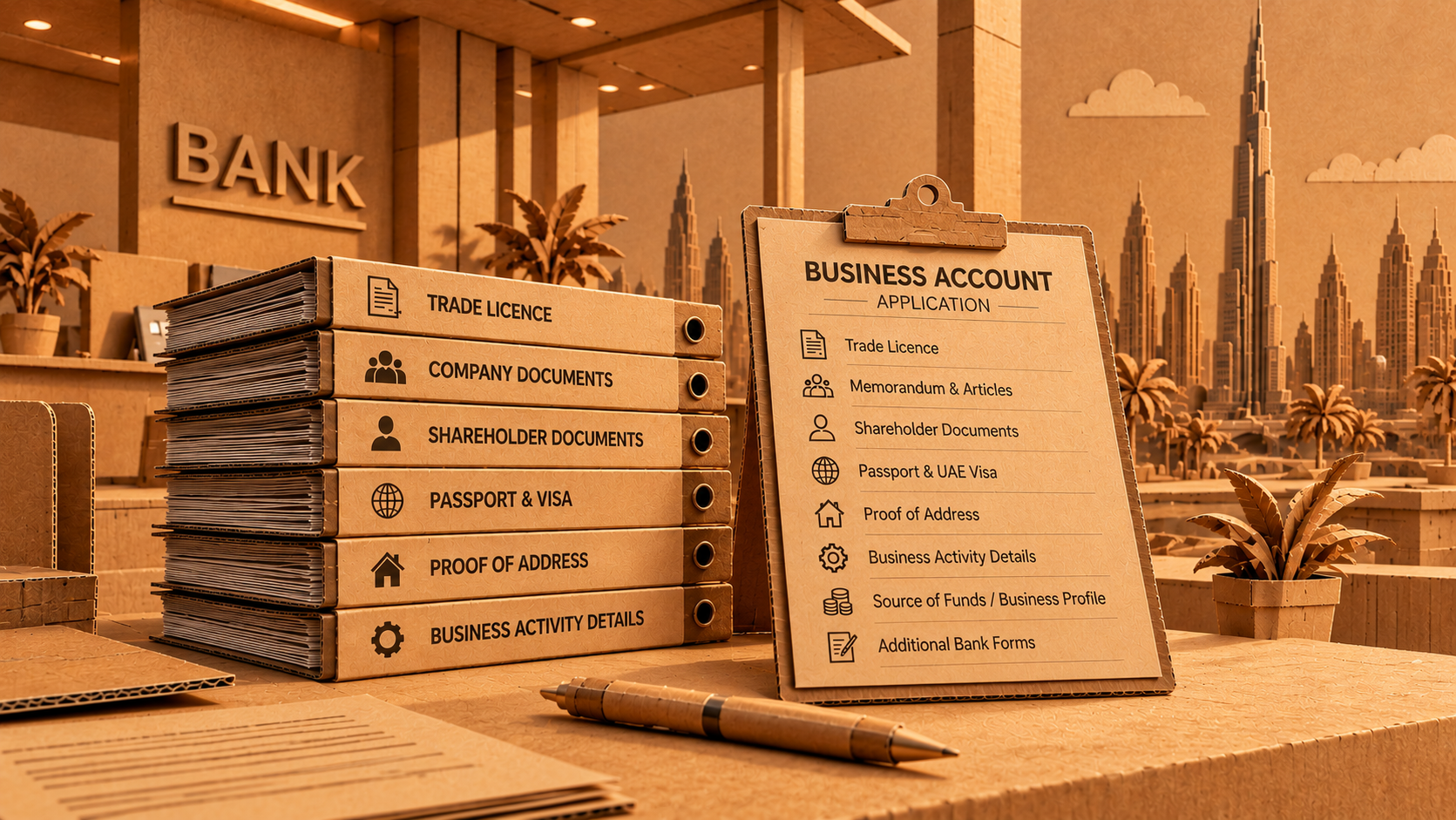
Opening a business bank account in the UAE is an important step for entrepreneurs, start-ups, SMEs, and established companies operating in Dubai and across the Emirates. However, obtaining a UAE trade licence does not automatically guarantee approval for a corporate bank account.
Banks conduct detailed verification before accepting a business banking application. They review company registration documents, shareholder information, business activities, financial details, and the source of funds to understand how the company operates.
Whether you are establishing a mainland company, free zone business, or an eligible offshore entity, understanding the UAE business bank account opening requirements can help you prepare a stronger application and avoid unnecessary delays.
In this guide, AD Firms Business Services explains the documents UAE banks commonly check, why they matter, and how businesses can prepare for the corporate bank account opening process.
1. Valid UAE Trade Licence
One of the first documents a bank typically requests is a valid UAE trade licence.
Your trade licence confirms that your company is registered and authorised to conduct specified business activities.
Banks generally verify:
Registered company name
Trade licence number and validity
Approved business activities
Licensing authority
Mainland or free zone jurisdiction
Consistency between the licence and your declared operations
Why does this matter?
Banks need to understand whether the business activities you intend to conduct match the activities permitted under your licence.
For example, if your trade licence covers management consultancy but your expected transactions relate primarily to importing and exporting physical products, the bank may request further clarification.
Before applying for a business bank account in Dubai, ensure your licence accurately reflects your actual commercial operations.
2. Company Incorporation and Legal Documents
Banks also examine the company's legal structure and registration history.
Depending on the company type and jurisdiction, the required documents may include:
Certificate of Incorporation or Registration
Memorandum of Association (MOA)
Articles of Association (AOA), where applicable
Shareholder register or ownership documents
Certificate of Incumbency, where applicable
Board resolution authorising account opening
Documents identifying authorised signatories
These documents help banks identify who owns, manages, and controls the company.
For companies with multiple shareholders or corporate shareholders, banks may require additional information to establish the complete ownership structure.
AD Firms Business Services can assist companies in organising their corporate documentation before submitting a UAE business banking application.
3. Passport, Emirates ID and Visa Documents
Identity verification is a core component of the UAE banking process.
Banks commonly request identification documents from shareholders, directors, authorised signatories, and ultimate beneficial owners (UBOs), as applicable.
Documents may include:
Valid passport copies
Emirates ID copies for UAE residents
UAE residence visa details, where applicable
Proof of residential address
Additional identification for non-resident shareholders
The bank may also require certain individuals to complete identity verification or attend an in-person or remote onboarding process.
Important: UAE residency requirements differ between banks and account products. Some banks consider eligible non-resident structures, while others impose stricter residency conditions.
Providing valid identification documents does not guarantee account approval.
4. Proof of Business Address
A company's registered address and actual operating location are important parts of the bank's due diligence.
Depending on the bank and business model, supporting documents may include:
Ejari or commercial tenancy agreement
Office lease agreement
Free zone facility agreement
Flexi-desk or coworking agreement
Recent utility bill, where applicable
Other acceptable evidence of business premises
Banks may examine whether the stated business location is consistent with the company's size, industry, and operational requirements.
For example, a consultancy operating from a flexi-desk may have different premises requirements from a company involved in warehousing or large-scale trading.
Having a flexi-desk arrangement does not automatically disqualify a company from opening a bank account. Acceptance depends on the bank's policies and its assessment of the business.
5. Business Activity and Company Profile
A bank needs more than a trade licence to understand how your business will operate.
A clear company profile can help explain your commercial activities and expected banking requirements.
A useful business profile typically includes:
Description of products or services
Target customers and markets
Expected suppliers and business partners
Countries where the company will operate
Expected monthly transaction volume
Anticipated average transaction value
Expected annual turnover
Business website or professional online presence
Banks may also ask whether the company expects domestic payments, international transfers, cash transactions, or transactions in foreign currencies.
Why is this important?
Banks assess whether your expected account activity is reasonable for the nature and scale of your business.
Unclear or inconsistent information can result in additional questions or extended verification.
6. Source of Funds and Source of Wealth
Source of funds verification is a significant part of corporate bank account due diligence in the UAE.
Banks may need to understand where the money entering the business account originates.
Depending on the circumstances, supporting evidence may include:
Personal or corporate bank statements
Evidence of shareholder capital contributions
Business income records
Sale agreements
Investment documentation
Financial statements
Other documents demonstrating the origin of funds
Banks may also request source of wealth information from beneficial owners to understand how their overall wealth was accumulated.
For newly established businesses, the bank may focus on initial capital, the shareholders' professional background, and the company's expected revenue sources.
Key point: Source of funds and source of wealth are related but different checks. Banks may request evidence for both.
7. Invoices, Contracts and Business Transaction Evidence
Another important area of verification is proof of genuine business activity.
Banks may request commercial documents to support your declared operations.
Examples include:
Customer agreements
Supplier contracts
Purchase orders
Sales invoices
Service agreements
Letters of intent
Existing business transaction records
These documents help demonstrate the commercial purpose of the account.
However, newly incorporated businesses may not yet have invoices or completed transactions. In such cases, banks may consider alternative supporting evidence, depending on their requirements.
Avoid submitting fabricated invoices, artificial contracts, or misleading financial projections. Inaccurate information can seriously affect your application.
8. Shareholder and Ultimate Beneficial Owner Information
UAE banks conduct ownership checks to identify the individuals who ultimately own or control a business.
This process is part of their Know Your Customer (KYC) and anti-money laundering (AML) obligations.
Banks may examine:
Direct and indirect shareholders
Ultimate beneficial owners
Ownership percentages
Company management structure
Authorised account signatories
Corporate shareholders and parent companies
Ownership across multiple legal entities
Businesses with complex ownership arrangements may face additional documentation requirements.
Providing a clear ownership chart and consistent shareholder information can help make the verification process more straightforward.
9. Financial Statements and Expected Account Activity
Existing companies may be asked to provide financial records showing their trading history and financial position.
Depending on the bank, documents may include:
Audited financial statements
Management accounts
Previous corporate bank statements
VAT registration details, where applicable
Financial projections
Expected account turnover
New companies may instead be asked to provide reasonable business forecasts and evidence supporting their anticipated activities.
Some UAE business accounts also have minimum balance requirements, monthly fees, or transaction restrictions.
These conditions vary by bank and account type, so businesses should review the applicable terms before applying.
10. Additional Compliance and Bank-Specific Documents
Not every UAE bank follows exactly the same onboarding process.
Depending on the business activity, jurisdiction, ownership structure, and risk assessment, a bank may request additional information.
This can include:
Tax residency declarations
FATCA and CRS self-certifications
Industry-specific permits or approvals
Supporting documents for overseas transactions
Details of major customers and suppliers
Explanation of high-value or unusual transactions
Additional compliance questionnaires
Companies involved in regulated or higher-risk activities may face enhanced due diligence.
The final document checklist is determined by the bank, not by the business setup consultant.
Why Do UAE Business Bank Account Applications Get Delayed?
Even when a company holds a valid trade licence, its bank account application may take longer than expected.
Common reasons include:
Incomplete documentation: Missing ownership records, identification documents, or supporting evidence can slow the review.
Inconsistent business information: Differences between the trade licence, company profile, and declared transactions may require clarification.
Unclear source of funds: Banks may need further evidence to understand the origin of business capital.
Complex shareholder structures: Multiple corporate shareholders or overseas ownership arrangements can require additional verification.
Limited business activity evidence: Newly incorporated companies may need to provide alternative proof of their intended commercial operations.
Bank-specific eligibility criteria: A company may satisfy the requirements of one banking product but not another.
Preparing complete and accurate documents before submission can reduce avoidable delays, although it cannot eliminate compliance checks or guarantee approval.
How AD Firms Helps With UAE Corporate Bank Account Opening
Opening a corporate bank account requires more than simply submitting a trade licence and passport.
Businesses need to understand documentation requirements, prepare consistent company information, and identify banking options suited to their activities.
AD Firms Business Services supports entrepreneurs and companies in Dubai and across the UAE with business setup and corporate banking assistance.
Our support can include:
Reviewing business banking documentation requirements
Assisting with company profile preparation
Organising trade licence and incorporation documents
Helping businesses understand bank-specific application requirements
Coordinating corporate bank account opening enquiries
Guiding applicants through documentation and follow-up requirements
All bank account applications remain subject to the bank's independent eligibility checks, compliance review, and final approval.
Frequently Asked Questions
Can I open a UAE business bank account with only a trade licence?
Generally, no. Banks usually require additional information such as identification documents, company incorporation records, ownership details, business activity information, and source of funds evidence.
Do UAE banks require an Emirates ID to open a company account?
Requirements depend on the bank, the applicant's residency status, and the account product. Emirates ID is commonly requested for UAE-resident applicants, while eligible non-resident applications may involve different documentation.
Can a newly established UAE company open a corporate bank account?
Yes, newly incorporated companies may apply for business bank accounts. Banks will assess their eligibility, ownership, intended activities, funding sources, and supporting documents.
Is an office required for UAE business bank account opening?
Not necessarily in every case. Banks assess the registered address, operating arrangements, business activities, and their own policies. Certain account products or business types may require stronger evidence of physical premises.
How long does it take to open a business bank account in Dubai?
There is no universal processing time. The duration depends on the bank, completeness of documentation, company structure, due diligence requirements, and any additional verification requested.
Can a free zone company open a UAE business bank account?
Yes, eligible UAE free zone companies can apply for corporate bank accounts. Approval depends on the bank's policies, company documentation, business activities, and compliance assessment.
Final Thoughts
Understanding what documents banks check before opening a UAE business account is essential for entrepreneurs who want to avoid preventable application delays.
From trade licences and shareholder identification to business profiles, financial information, and source of funds evidence, each document helps banks evaluate the company's legitimacy and expected operations.
The most effective approach is to prepare complete, accurate, and consistent information before approaching a bank.
Planning to open a business bank account in Dubai or anywhere in the UAE?
Contact AD Firms Business Services for assistance with corporate banking documentation, company formation, and business setup requirements.
AD Firms Business Services — Supporting Your Business Journey in the UAE.